| Lesson 2 | Review sequence diagram notation |
| Objective | Review the Notation for a Sequence Diagram |
Review Sequence Diagram Notation
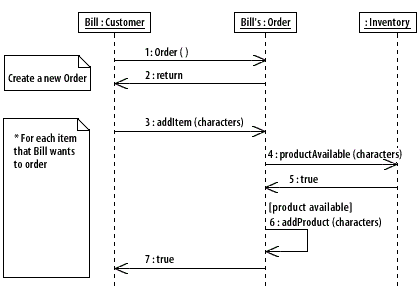
The sequence diagram illustrates objects talking to one another over time. To do so, the diagram uses objects, timelines, and event arrows.
The diagram consists of a set of participating objects lined up across the top of the diagram. A timeline is drawn down from each object.
- Event/message
- Return
- Sequence number
- Self-reference
- Object name
- Anonymous object
- Iteration comment
- Basic comment
- Event signature
- Condition
Sequence Diagram Example
You will note from the diagram above:
- The objects use standard object notation, that is, a rectangle containing the object name, a colon, and the class name of the object.
All three of these elements are underlined. The object name is optional. You may use just the colon and class name:
ObjectName:ClassName - The timeline is a vertical dashed line.
- The events appear as arrows.
Domain Driven Design
Event Shown Horizontal
An event is shown as a horizontal arrow from the timeline of the "sending" object to the timeline of the "receiving" object.
A return from an event is shown as a horizontal arrow from the "receiving" object back to the "sending" object.
Return Arrow Line
Some tools support a different kind of line for the return arrow, for example, a dashed line instead of a solid line. This is extremely useful because the two events are handled so differently.
Order of events
The position on the timeline indicates a relative point in time. The top of the line represents the beginning of the timeline.
The bottom represents the end of the timeline.
